
What should you know before adding organic sage essential oil to your aromatherapy routine? First, check the botanical name. Common sage essential oil comes from Salvia officinalis, while clary sage essential oil comes from Salvia sclarea. They have different aromas and chemical profiles. Choose a clearly labelled product, understand its safety precautions, and never assume that organic means risk-free.

Have you ever wondered what makes sage essential oil different from the sage leaves used in cooking?
Organic sage essential oil is a concentrated aromatic oil usually obtained through steam distillation of Salvia officinalis leaves. Also known as common sage or garden sage, this plant has a strong, herbaceous, warm, and slightly camphor-like aroma.
But what does the word organic actually tell you?
It describes how the plant was grown and certified under an applicable organic standard. It does not automatically tell you the oil’s chemical composition, purity, or safety for every person.
The chemical profile of common sage oil can include compounds such as thujone and camphor. Their levels vary between batches, depending on factors such as the plant material and production process.
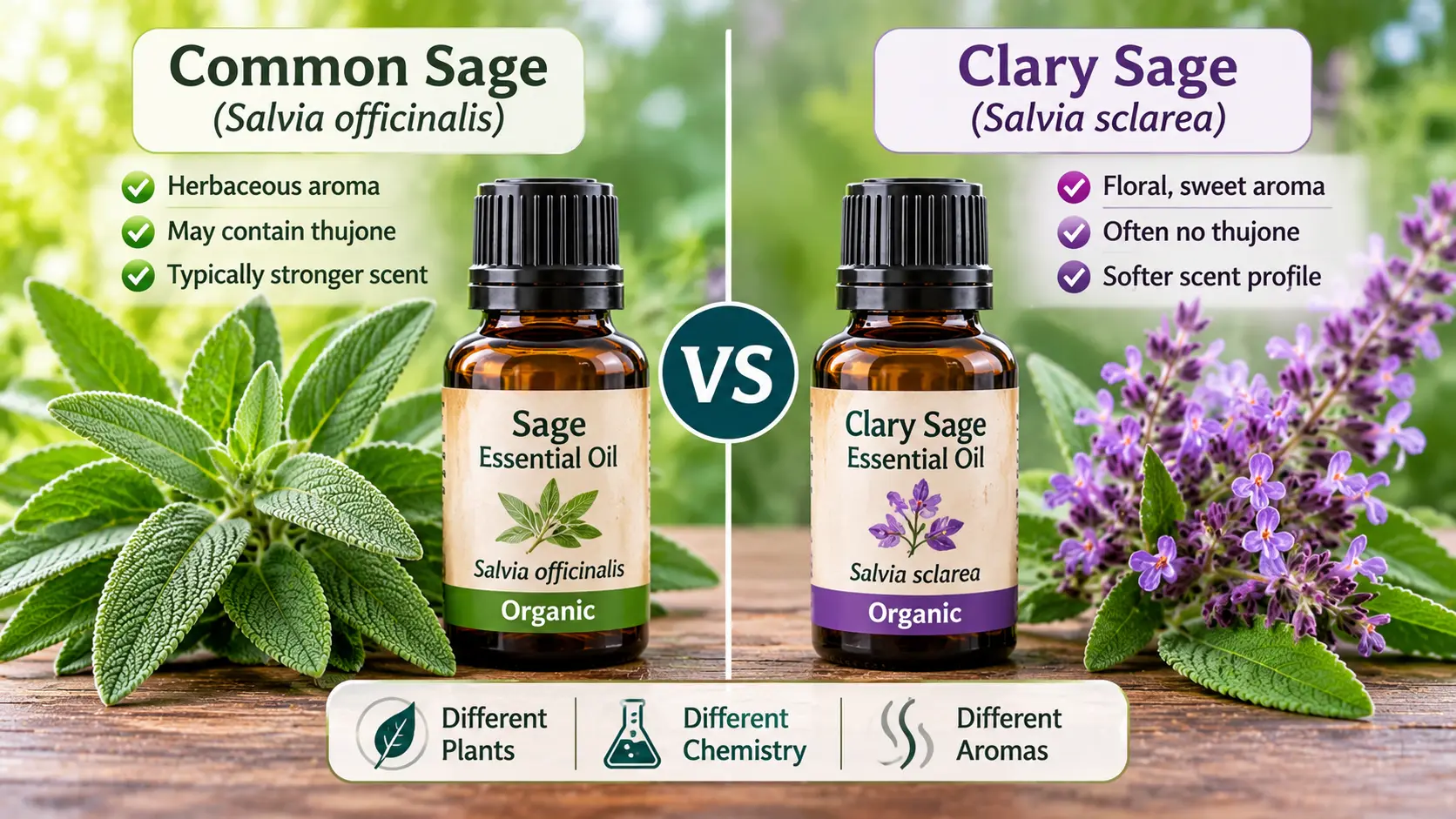
If both bottles say “sage essential oil,” how can you tell which one you’re buying?
Look for the Latin botanical name:
Although they belong to the same plant genus, they are different species.
Common sage essential oil generally has a stronger, sharper, herbaceous aroma. Clary sage essential oil is often described as softer, sweeter, and more floral.
Why does this difference matter? Their chemical compositions are not interchangeable. Common sage oil can contain thujone, while clary sage typically has a different profile, often featuring linalyl acetate and linalool.
A bottle labelled only “sage” does not give you enough information. Check the botanical name, plant part, extraction method, and batch documentation. A batch-specific GC/MS report can provide more detail about the oil’s chemical composition.

Does a green label or the word “natural” prove that an essential oil is organic?
No. Packaging language alone is not proof of organic certification.
When shopping for organic sage essential oil, look for:
If a product claims USDA organic certification, check whether its label meets the USDA’s rules. The USDA organic seal is not permitted on every product that contains some organic ingredients.
Remember: organic describes production standards. It does not remove naturally occurring compounds such as thujone or change the need for safe handling.
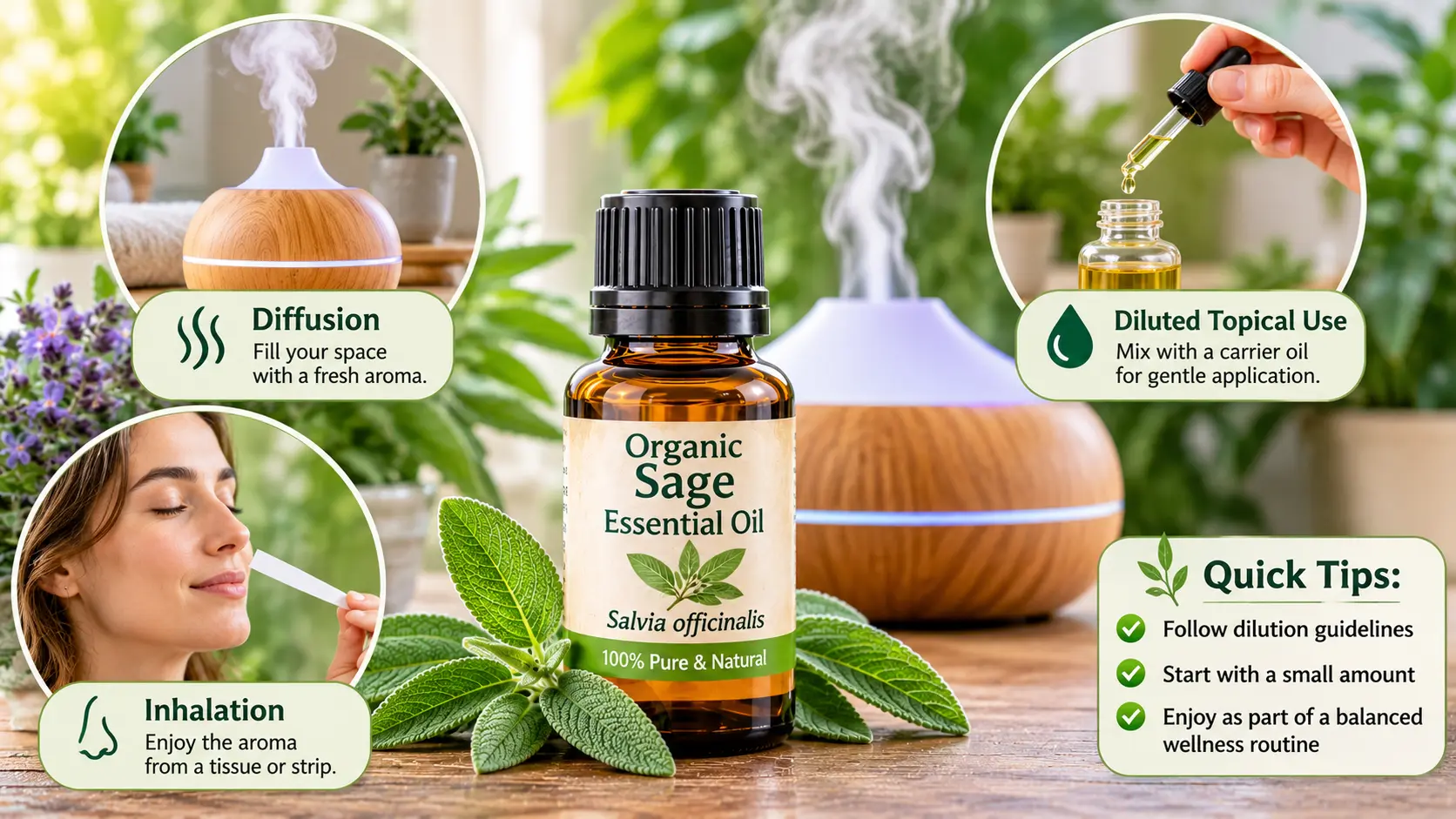
Choosing an organic sage essential oil involves more than comparing packaging, fragrance, or price.
Before purchasing, examine the product information carefully.
1. Verify the botanical identity
Look for Salvia officinalis if you specifically want common sage essential oil. Do not rely on the word “sage” alone.
2. Check the organic certification
Look for the certifier’s name, certification details, and applicable organic standard. Where possible, verify the certification independently.
3. Review the GC/MS report
A batch-specific gas chromatography–mass spectrometry (GC/MS) report can help identify the oil’s major chemical constituents, including thujone and camphor.
4. Examine the packaging
Choose a product with a clearly identified botanical name, batch number, ingredient information, and appropriate storage instructions.
5. Understand the intended use
Not every essential oil is suitable for diffusion, topical application, or other uses. Follow the manufacturer’s instructions and relevant safety guidance.
Remember that a premium price, strong fragrance, or organic label alone cannot establish an essential oil’s purity or safety.
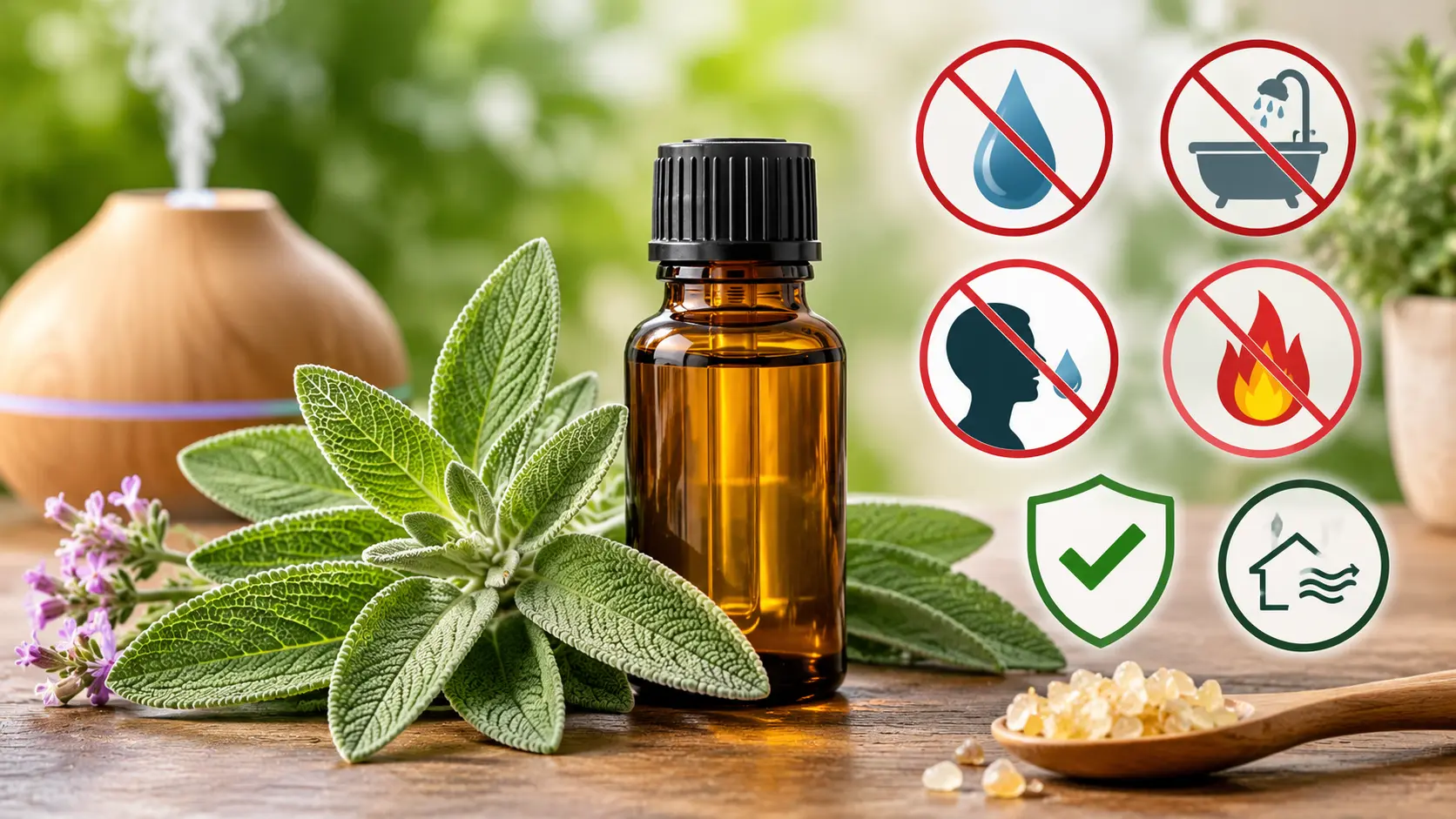
Once you’ve identified the oil, what is the next question? How can you enjoy its aroma without using it carelessly?
A simple sage essential oil aromatherapy routine can involve different methods, but the right approach depends on the oil, the product instructions, and your personal circumstances.
Common aromatherapy formats include:
Are these methods proven to treat health conditions? No. Research into aromatherapy effects is mixed, and an appealing scent should not be presented as a substitute for medical care.
For practical guidance, consult a qualified aromatherapist and a recognised essential-oil safety resource.
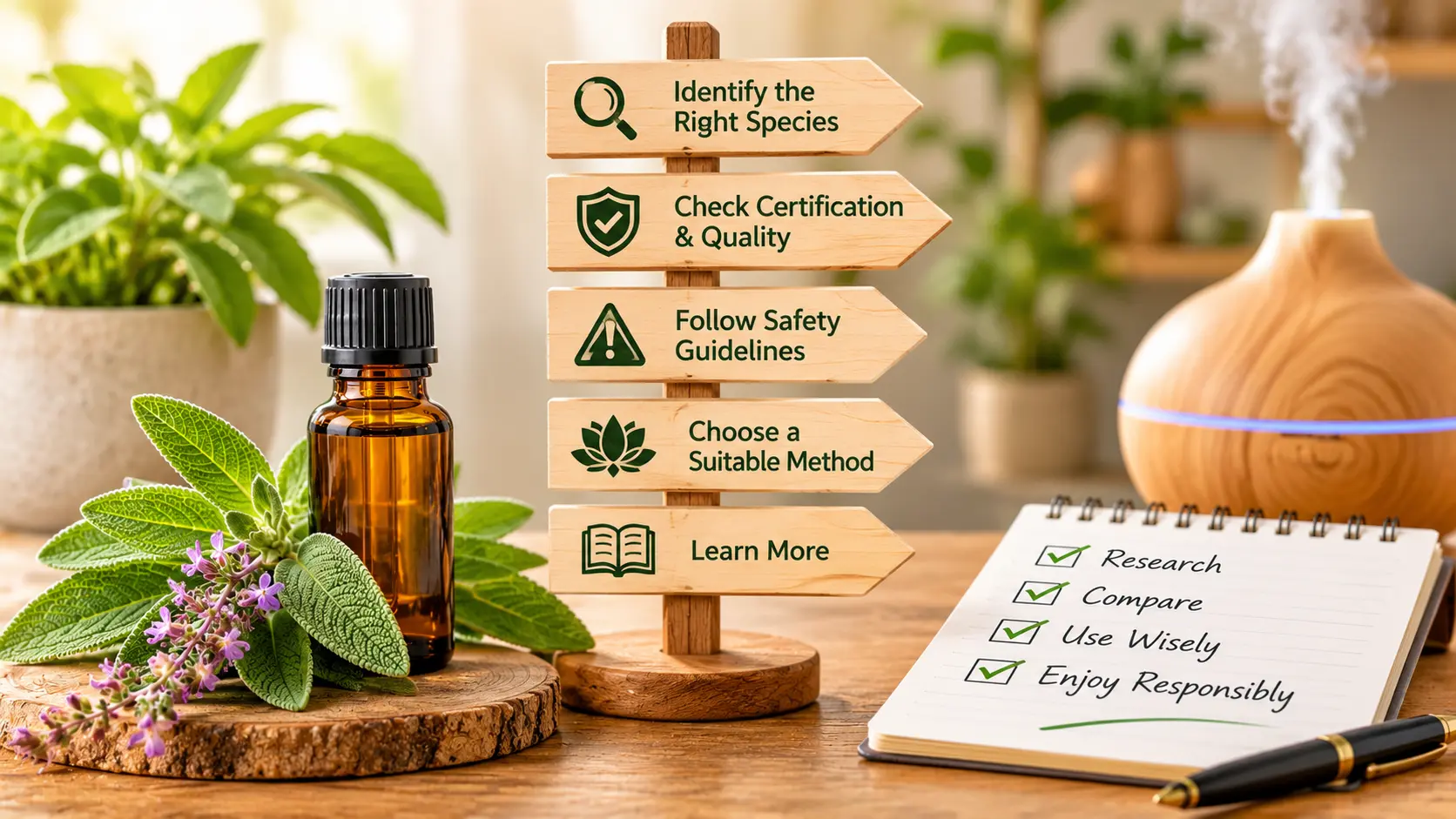
If essential oils come from plants, does that automatically make them gentle?
Not necessarily. Essential oils are highly concentrated. Their safety depends on the specific oil, its chemical composition, the amount used, and the way you use it.
Keep these basic precautions in mind:
If you have asthma, epilepsy, a skin condition, or take prescribed medication, seek professional advice before using essential oils.
Should you use common sage essential oil during pregnancy simply because it is labelled organic?
No. Organic certification does not remove the specific safety concerns associated with common sage oil.
The European Medicines Agency’s assessment of Salvia officinalis essential oil highlights concerns about its thujone content. Its assessment report identifies pregnancy and breastfeeding as situations in which sage oil is contraindicated.
Clary sage is a different oil, but that does not mean it is automatically suitable during pregnancy. Ask your healthcare professional before using either oil while pregnant or breastfeeding.
When the safety information is uncertain, the sensible choice is to avoid experimenting with concentrated essential oils.
Can you use the same aromatherapy routine around everyone in your home?
No. Children and animals can have different sensitivities and exposure risks.
For children:
For pets:
Cats deserve particular caution because they may be exposed through inhalation or by grooming oil residue from their fur.
So, is organic sage essential oil the right choice for your aromatherapy routine?
Start by identifying the exact plant species. Common sage and clary sage are different oils, with different aromas and chemical profiles. Then check the product’s certification, batch information, and safety guidance.
A thoughtful aromatherapy routine is not about using more oil. It is about knowing what you have, understanding its limitations, and choosing a suitable way to enjoy its aroma.
Explore UhRohMuh for general aromatherapy education and related products as you build a more informed routine.
This article is for educational purposes only and is not medical advice. Essential oils are concentrated substances. Consult a healthcare professional or qualified aromatherapist for advice about your individual circumstances.
Premium Pure Sage Essential Oil for Aromatherapy & Wellness
No. Common sage essential oil comes from Salvia officinalis, while clary sage essential oil comes from Salvia sclarea. They have different aromas and chemical profiles.
No. Organic certification relates to how the plant was produced and certified. It does not guarantee that the oil is safe for every use or remove naturally occurring compounds such as thujone.
Common sage essential oil is generally advised against during pregnancy because of safety concerns associated with its thujone content. Ask your healthcare professional before using any essential oil during pregnancy or breastfeeding.
Not automatically. Essential oils can expose pets through inhalation or contact with surfaces and fur. Use caution, provide access to fresh air, and ask a veterinarian before diffusing oils around animals.
Clary sage essential oil (Salvia sclarea) has a different chemical profile and is not typically associated with the same thujone levels as common sage. However, it has its own safety considerations and should not be assumed to be suitable for everyone.
This article was prepared by the UhRohMuh editorial team, with a focus on essential oil education, aromatherapy practices, botanical identification, and responsible product selection.
Our content aims to help readers understand essential oil ingredients, product labelling, potential safety considerations, and evidence-based aromatherapy information.
Medical and safety review: Safety-related information should be reviewed by a suitably qualified healthcare professional or aromatherapy safety specialist before publication.








You must be logged in to post a comment.